Abbreviation Definition and Usage
What is an Abbreviation?
Both in formal and informal speech, we don’t always write the whole word or phrase and use a shortened form instead. For example, it’s common to come across an “etc.” or “i.e.” in an essay and an “OMG” or “FYI” in a text message you receive from a friend. All of these are abbreviations.
Even though it might seem that abbreviations are a rather modern phenomenon that exploded due to technology and text messages, they’ve actually been around for thousands of years. In fact, in ancient Greece and Rome, it was common to shorten words by their first letter. As for the English language, it’s been full of abbreviations from the very beginning. Beowulf, an Old English epic poem from some time around the tenth century, is only one example of works that had shortened forms of words in them.
Why Do We Use Abbreviations?
The reason why abbreviations have been popular hundreds of years ago and why they still remain so today is that they help us save space and time. Obviously, it takes a lot less effort to write SARS than it would if you were to write “Severe Acute Respiratory Syndrome”, the whole phrase that it stands for. In addition, in the modern world, there sometimes is the need to fit as much information as possible into one message while having a limited amount of characters. For instance, Twitter doesn’t allow tweets to be longer than 280 characters. It’s natural to shorten all the words that can be shortened, to make sure that everything you want to say fits into a single tweet.
Abbreviations can take various forms, and there isn’t a rule that would strictly define how words can or can’t be shortened. One option is representing the word by its first letter or by the first few letters, e.g. v. for verb and Co. for company. Some abbreviations take the most important letters of the word, such as Ltd. that stands for limited, or Revd that stands for Reverend. A single word can also be shortened by taking only the first and the last letter, e.g. Dr. for Doctor, Rd. for road. It’s also common that first letters of the words in a phrase are used instead of a whole phrase. Examples are BTW for by the way and RSVP for répondez s’il vous plaît.
Many abbreviations appeared at the end of the 20th century when people started sending each other text messages. These are most commonly first letters of the words in a phrase, such as TMI that stands for too much information. Sometimes letters are replaced with numbers to make an abbreviation; thus, L8r stands for later.
Often quite a few questions arise when it comes to abbreviations. Do I use a full stop after the shortened version of the word? Do I use lowercase or uppercase letters? What do I do if I need a plural form? These are just some of those questions. However, just as it is with the majority of English grammar, practice makes perfect. If you keep using abbreviations in your writing, you soon will have no problems with them.
Abbreviations List
List of different types of abbreviations with meaning in English.
Business & Finance Abbreviations
Examples of common business abbreviations in English.
- Assoc. = Association
- Corp. = Corporation
- Inc. = Incorporated
- Ltd. = Limited
- BKPR = Bookkeeper
- LET = Leaving Early Today
- FTE = Full-time Employee
- OTP = On The Phone
- WOM = Word of Mouth
- IAM = In A Meeting
- NIM = No Internal Message
- PTE = Part-time Employee
- NRN = No Reply Necessary
- WIIFM = What’s In It For Me
- WFH = Work From Home
- HQ = Headquarters
- LLC = Limited Liability Corp.
Marketing & Sales Acronyms
Examples of sales and marketing acronyms in English.
- B2B = Business to Business
- B2C = Business to Customer
- BR = Bounce Rate
- CMS = Content Management System
- CPC = Cost Per Click
- CTA = Call to Action
- CTR = Click Through Rate
- CR = Conversion Rate
- DM = Direct Message
- SEO = Search Engine Optimization
- SM = Social Media
- SWOT = Streng, Weekness, Opportunity, Threat
- CX = Customer Experience
- FB = Facebook
- POS = Point of Sale
- PV = Page Views
- RTD = Real Time Data
- SEM = Search Engine Marketing
- SMM = Social Media Marketing
- SMS = Short Message Service
Medical Abbreviations
- a.c. = Before meals
- a/g ratio = Albumin to globulin ratio.
- b.i.d. = Twice daily
- bld = Blood
- BP = Blood Pressure
- C/O = Complaint of
- ETOH = Alcohol
- ECT = Electro Conclusive Therapy
- g = gram
- GvHD = Graft vs. Host Disease
- gtt = Drops
- h.s. = At bedtime
- HA = Headache
- ICU = Intensive Care Unit
- ITU = Intensive Therapy Unit
- in vitro = In the laboratory
- in vivo = In the body
- IU = International Units
- JT = Joint
- LBP = Low Back Pain
- mg = Milligrams
- ml = Milliliters
- M/H = Medical History
- MVP = Mitral Valve Prolapse
- N/V = Nausea or Vomiting
- NCP = Nursing Care Plan
- npo = Nothing by mouth
- NSR = Normal sinus rhythm of the heart
- O.D. = Right eye
- O.S. = Left eye
- O.U. = Both eyes
- P = Pulse
- p.o. = By mouth
- p.r.n. = As needed
- PD = Progressive disease
- PT = Physical therapy
- q.d. = Each day
- q2h = Every 2 hours
- qAM = Each morning
- qhs = At each bedtime
- qod = Every other day
- qPM = Each evening
- s/p = Status post
- SOB = Shortness of Breath
- T = Temperature
- tab = Tablet
- Wt = Weight
- P = President
- VP = President
- SVP = Senior Vice President
- EVP = Executive Vice President
- CMO = Chief Marketing Officer
- CFO = Chief Financial Officer
- CEO = Chief Executive Officer
- PA = Personal Assistant
- Dpt. = Department
- Gov. = Government
- Mgmt. = Management
- Pol. = Politics
- Capt. = Captain
- Col. = Colonel
- Dr. = Doctor
- Gen. = General
- Lt. = Lieutenant
- MD = Medical Doctor
- Mr. = Mister
- Prof. = Professor
- RN = Registered Nurse
- St. = Saint
- Sgt. = Sergeant
- Sr. = Senior
- Etc. = And more
- E.g. = For example
- I.e. = For example
- W/= With
- W/O = Without
- B/c = Because
- B/4 = Before
- Ea. = Each
- Fr. = From
- S/t = Something
- Gen. = Generally
- E/o = Either/ or
- Max = Maximum
- Min = Minimum
- Diff = Difference
- Approx = Approximately
- Cf = Compared to
- V. = Very
- Vs. = Against
- K = thousand
- Subj. = Subject
- Int’l = International
- <= Less than
- >= Greater than
- & = And
- @ = At
Title Abbreviations
Note Taking/ Writing Abbreviations
Examples of common abbreviations for note taking.
Time Abbreviations
- AM = Ante Meridiem (before noon)
- PM = Post Meridiem (afternoon)
- AD = After the Year 0
- BC = Before the Year 0
- hr = Hour
- min = Minute
- sec = Second
Postal Terms & Direction Terms
- Apt. = Apartment
- Ave. = Avenue
- Ct. = Court
- Dr. = Drive
- Hwy. = Highway
- Ln. = Lane
- Mt. = Mountain/ Mount
- Rd. = Road
- St. = Street
- Ste. = Suite
- N = North
- S = South
- E = East
- W = West
- Gal. = Gallon
- Lb. = Pounds
- Pt. = Pints
- Qt. = Quarts
- G = Gram
- Kg = Kilogram
- Cm = Centimeter
- M = Meter
- ft. = foot
- in. = inch
- mi. = mile
- mph. = miles per hour
- mg. = milligram
- mm = milimeter
- no. = number
- oz = ounce
- sq = square
- vol. = volume
- Calif. = California
- Colo. = Colorado
- D.C. = District of Columbia
- Ga. = Georgia
- Ind. = Indiana
- Mich. = Michigan
- Mont. = Montana
- N.M. = New Mexico
- N.J. = New Jersey
- N.Y. = New York
- S.C. = South Carolina
Measurement Abbreviations
State Abbreviations
English Teaching Abbreviations
Examples of abbreviations for English language teaching.
- BC: British Council
- BE: Business English
- BVT: Bilingual Vocational Training
- CALI: Computer Assisted Language Instruction
- CALL: Computer Assisted Language Learning
- CanE: Canadian English
- EAP: English for Academic Purposes
- EFL: English as a Foreign Language
- EGP: English for General Purposes
- EIP: English as an International Language Programme
- EL: English Learner
- ELA: English Language Arts
- ELD: English Language Development
- ELT: English Language Teaching
- ERIC: Educational Resources Information Center
- ESL: English as a Second Language
- ESLP: English as a Second Language Programme
- ESOL: English for Speakers of Other Languages
- IEP: Intensive English Programme (usually university programmes)
- NEP: Non-English Proficient
- NES: Non-English Speaking
- NNEST: Non-Native English Speaking Teacher
- OE: Old English
- OED: Oxford English Dictionary
- SAE: Standard American English
- SAP: Student Assistance Program
- SLL: Second Language Learner
- TEFLA: Teaching English as a Foreign Language to Adults
- TEIL: Teaching English as an International Language
- TESL: Teaching English as a Second Language
- TYLE: (Teaching) Young Learners English
- VESL: Vocational English as a Second Language
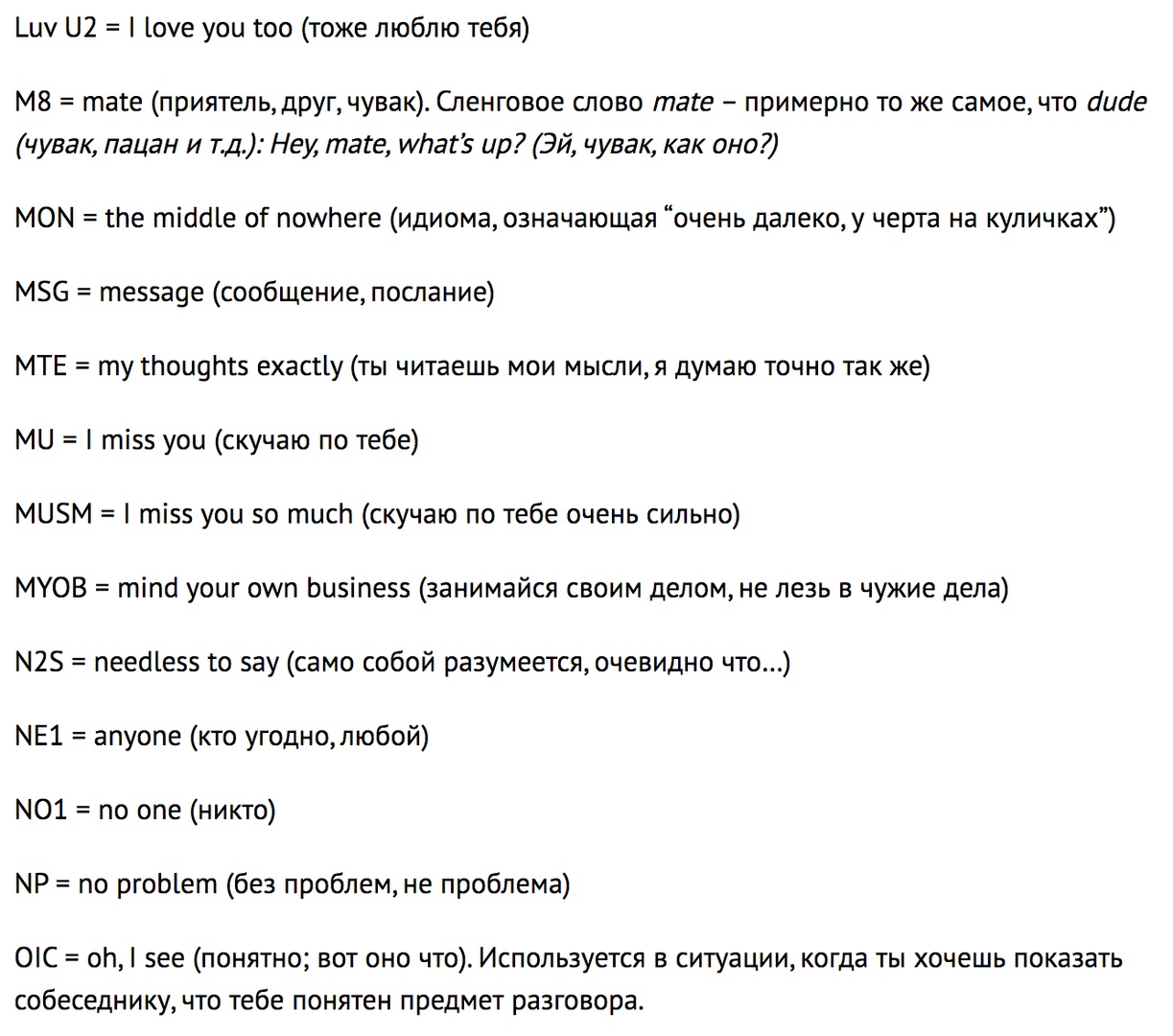
Internet Acronyms & Text Abbreviations
Examples of text abbreviations and internet slang words.
- SMH = Shaking my head
- BRB = Be right back
- IMO = In my opinion
- CYA = Cover Your A** or See Ya
- DIKY = Do I Know You?
- IDK / IDKE = I Don’t Know / I Don’t Know Either
- ILY = I Love You
- HBU = How About You?
- LMAO = Laughing My A** Off
- LMK = Let Me Know
- NVM = Nevermind
- OFC = Of Course
- PNL = Peace and Love
- ROFL = Rolling on the Floor Laughing
- SNMP = So Not My Problem
- STFU = Shut the F*** Up
- TAY = Thinking About You
- TBH = To Be Honest
- TTP = To the Point
- QAP = Quick as Possible
- YGTI = You Get the Idea
- AMA = Ask Me Anything
- DAE = Does Anyone Else?
- ELI5 = Explain Like I’m 5
- TIL = Today I Learned
- FTFY = Fixed That For You
- BAE = Babe or Before Anyone Else
- Facepalm = Seriously?
- HIFW = How I Feel/Felt When
- MFW/MRW = My Face When / My Reaction When
- ICYMI = In Case You Missed It
- JSYK = Just So You Know
- Lulz = Laughs
- IRL = In Real Life
- MIRL = Me in Real Life
- PAW = Parents Are Watching
- QFT = Quoted for Truth
- TBT = Throwback Thursday
- TL;DR = Too Long; Didn’t Read
- YMMV = Your Mileage May Vary
- YOLO = You Only Live Once
- DOKY = Do I Know You?
- Noob = Newbie
- NSFW = Not Safe For Work